
The Turning Point: The Metaphysical Question in the Stream of Islamic Philosophy
Islamic philosophy is the “Philosophy of Living Inheritance.” It was not a mere repetition of what came before, but a crucible in which Eastern contemplations and Greek wisdom melted under the sun of Quranic Revelation. Even before the era of translation, the “bricks” of the metaphysical question had begun to emerge from the heart of the Quranic text, which posed major ontological challenges that shook the ancient Arab consciousness, shifting it from tribal sensory concerns to the horizons of cosmic abstraction.
1. Theoretical Challenges in the Quranic Text: The Dawn of Monotheistic Metaphysics
The Quranic text generated quintessentially metaphysical questions regarding the “Nature of the Creator,” the “Origin of Existence,” and “Human Destiny.” The problem of “Divine Attributes” emerged as the first metaphysical building block: How can one reconcile absolute transcendence (Tanzih), as in the verse: “There is nothing like unto Him”, with verses that attribute to Him a “Hand,” “Eye,” or “Istiwā” (Mounting the Throne)? This question ignited a debate on “Substance and Accident” and “Essence and Attribute” long before Aristotle’s works arrived.
Furthermore, the Prophetic experience introduced the question of “Revelation” as a bridge between the Absolute and the Relative, generating metaphysical inquiries into the “Nature of the Soul” and its capacity to connect with the Celestial Realm (Malakut). Quranic signals, such as the verse: “Allah is the Light of the heavens and the earth”, acted as the beacon that later guided Muslim philosophers toward the theories of “Emanation” (Fayd) and “Illumination” (Ishraq).
2. The Era of Translation: Summoning the Intellectual Weapons
During the Abbasid era, Muslims did not translate texts at random; they sought “tools” to answer their pending metaphysical dilemmas. The most crucial translated texts were:
- Aristotle’s Metaphysics: Translated by Hunayn ibn Ishaq and Yahya ibn Adi, it provided the “conceptual apparatus” (Causes, Substance, Potentiality, and Actuality) to organize discourse on the Necessary Being.
- The Theology of Aristotle: In reality, these were excerpts from Plotinus’s Enneads. This text had a decisive impact on merging the Plotinian “One” with the Islamic “Allah,” producing Al-Farabi’s Theory of Emanation.
- Commentaries by Greek Philosophers: Such as Porphyry’s Isagoge, which became the mandatory introduction to Logic as a servant to Metaphysics.
Islamic philosophy was not a “passive heir.” It utilized these texts to answer its central question: How can we demonstrate through Reason what has been transmitted through Revelation? Thus, the Aristotelian “Unmoved Mover” merged with the Avicennian “Necessary Being,” and Plato’s “Forms” were colored by the “Beautiful Names of Allah.” The metaphysical question in Islam became a “solid bedrock” combining Greek rigor, Eastern spirituality, and the eternity of the Quranic text.
We shall now dive deeper into the “Metaphysical Laboratory” of Islamic Peripateticism, where these philosophers did not merely transmit concepts but refashioned Greek ideas within a monotheistic context, using Aristotelian logic as a “Tool,” the Plotinian spirit as a “Horizon,” and the Prophetic experience as a “Criterion.”
1. Al-Kindi: The Philosophy of the "First Truth" and the Finitude of the World
Al-Kindi maintained that Metaphysics (First Philosophy) is the most noble of sciences because it investigates the First Cause. However, he collided with Aristotle regarding the “eternity of the world”; while Aristotle viewed the cosmos as eternal, the Quranic text views it as created ex nihilo (from nothingness).
- Metaphysical Method: Al-Kindi employed “mathematical logic” to prove that time, space, and motion are finite, and thus, the world must have a beginning.
- Key Text: In his treatise On First Philosophy, he writes:
“The First Cause is neither a genus nor a species; it is not a multiplicity but an Absolute One, indivisible and immutable… The True One is He who granted existence to every existent.”
- Illustrative Metaphor: Al-Kindi compared the relationship between God and the world to the relationship between the number “1” and all other numbers. The number “1” is the origin of all numbers—without it, no number exists—yet it is not a number like the others; it is the “principle of number,” distinct in its “oneness” and connected through its “creation” of the series.
2. Al-Farabi: The Reconciliation of the Two Sages and the System of "Emanation"
Al-Farabi believed that “Truth is one,” and that the conflict between Aristotle (the Logician) and Plato (the Spiritualist) was merely superficial. He utilized Neoplatonic texts to formulate the Theory of Emanation (Fayd), solving the dilemma: How does the Multiplicity (the world) emerge from the One (God)?
- Metaphysical Method: He established the “System of the Ten Intellects.” God (the First Existent) contemplates Himself, and from this contemplation, the “First Intellect” emanates, continuing until we reach the “Active Intellect” which governs our terrestrial world.
- Key Text: In The Political Regime (al-Siyasa al-Madaniyya), he writes:
“The First Existent is He from whose emanation all existents proceed… and what emanates from Him is not by way of human purpose or temporal choice, but is a necessary emanation, like light emanating from the sun.”
- Illustrative Metaphor: Al-Farabi posits that the “Prophet” is a human whose “imaginative faculty” has united with the Active Intellect (identified as the Archangel Gabriel in religious terms), receiving metaphysical truths in an instant without needing to arrange logical premises. Here, metaphysics shifts from “Inquiry” to “Revelation.”
3. Avicenna (Ibn Sina): Ontology and the Foundation of the "Necessary Being"
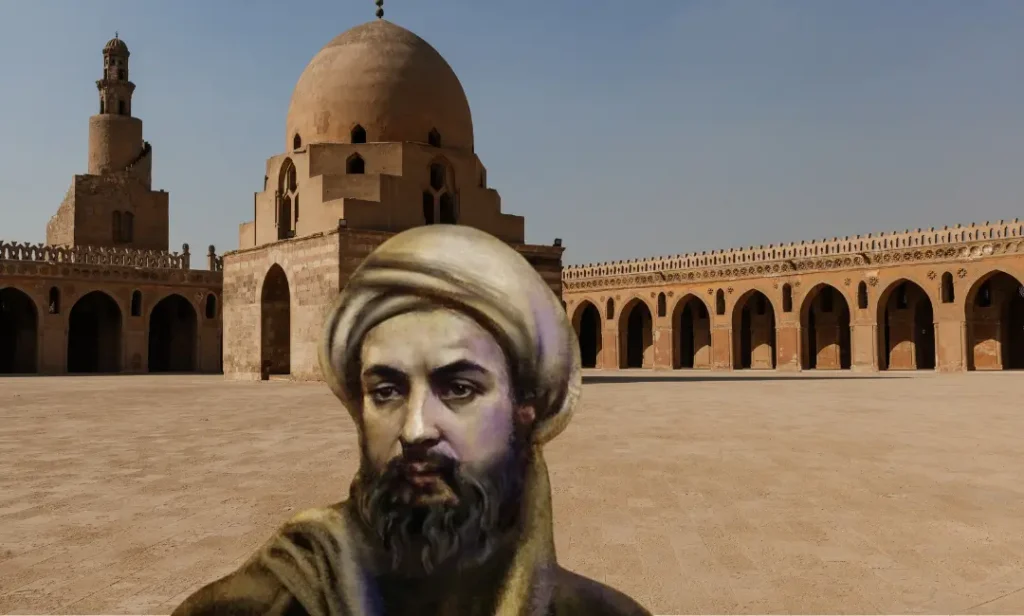
Avicenna termed metaphysics “Divine Science” and defined its subject as “Being qua Being.” His genius lay in moving beyond seeking God as a “Mover” (Aristotle’s approach) to seeking Him as the “Necessary Being” (Wajib al-Wujud).
- Metaphysical Method: He innovated the “Proof of the Truthful” (Burhan al-Siddiqin). If we assume the existence of anything, it must be either “Contingent” (requiring another to exist) or “Necessary” (existing by its own essence). Since an infinite regress is impossible, there must be a solid fulcrum: God.
- The “Floating Man” Metaphor: Avicenna proposed a thought experiment of a person born floating in a void, blindfolded and touching nothing. This person would be unaware of his body, yet he would never be unaware of the “existence of his self.” This self-awareness is the metaphysical bedrock proving that “Being” is the root of all knowledge.
The Remarks and Admonitions: A Metaphysical Awakening
Avicenna’s book, The Remarks and Admonitions (Al-Isharat wa al-Tanbihat), represents a profound “awakening” in his philosophical career. In this work, he is no longer the rigid Aristotelian confined to the molds of dry logic; instead, he begins a quiet rebellion against the “shackles of reason” in favor of “Gnostic Taste” (al-dhawq) and “Illuminative Intuition”.
1. From Demonstration to "Remark": Liberating Language
He replaced “Demonstrations” (Burhan) with “Remarks” (Isharat) and “Results” with “Admonitions” (Tanbihat). This is a metaphysical admission that ultimate truths (the Necessary, the Soul, Divine Joy) cannot be “contained” by logical language; language can only “point” toward them for the prepared mind to perceive.
- Analysis: He moves beyond Aristotelian “Demonstrative Proof” to focus on Intuition (Hads), which captures truth in a flash without the linear arrangement of premises.
2. The Proof of the Truthful: Existence as an Axiom
Avicenna abandoned “Matter” entirely in his proof of God. While Aristotle needed to observe “motion” in matter to prove a Mover, Avicenna proved the First through the very concept of Being itself.
- Key Text: “Reflect on how our demonstration of the First did not require us to reflect on anything other than Existence itself… we made the consideration of Existence qua Existence our starting point.”
3. Stations and Charismata: Entering "Philosophical Sufism"
The final section of the book (Stations of the Gnostics) is the true explosion against Aristotelian constraints. Here, he analyzes the experience of the “Knower” (al-Arif) not as a psychological state, but as an ontological rank.
- The Gnostic Quest: He speaks of “Union” (al-Ittihad), asserting that while logic may bring you to the shore of truth, “Gnosis” (al-Irfan) is what allows you to plunge into its sea.
- Key Text: “The Gnostic desires the Truth not for anything other than the Truth itself… he prefers nothing over his gnosis of the Truth.”
Avicenna thus liberated the metaphysical question from the “impurity” of matter and the “dryness” of logic, transforming it into a ladder for the soul’s ascent. This work became the bridge from Peripateticism to Illuminationism, paving the way for Suhrawardi and Ibn Arabi.
In his later stage, specifically in The Remarks and Admonitions (Al-Isharat wa al-Tanbihat), Avicenna represents the moment of emancipation from the rigor of “Peripateticism” toward what he termed “Oriental Wisdom” (Al-Hikma al-Mashriqiyya). For him, the metaphysical question was no longer a mere logical deduction; it was transformed into a “glad tiding” of an experiential opening that transcends dry Aristotelian molds. The “Sheikh al-Ra’is” realized that the demonstrative intellect, despite its power, remains incapable of perceiving existential truths in their entirety. Thus, he heralded a mode of knowledge rooted in “Intuition” and “Connection” (Ittisal).
In the section titled “The Stations of the Gnostics,” Avicenna lays the foundation for a “Gnostic Wisdom” (Al-Hikma al-Dhawqiyya) that links human perfection to the ability to escape the “captivity of matter” and ascend to the “Holy World.” Here, the metaphysical question no longer asks about the “essence of a thing,” but rather about the “mode of its presence” within the Gnostic’s consciousness. These early insights formed the seeds of what would later be known as “Transcendent Philosophy” (Al-Hikma al-Muta’aliyah), where demonstration is merged with gnosis (Irfan). Avicenna did not destroy logic; rather, he made it a “threshold” for ascending toward a higher spiritual experience. He maintained that the true philosopher is one who combines the power of inference with the depth of observation, transforming metaphysics from a “science of the absent” into a “witnessing of the presence.”
Hayy ibn Yaqdhan: The Narrative Realization of Oriental Wisdom
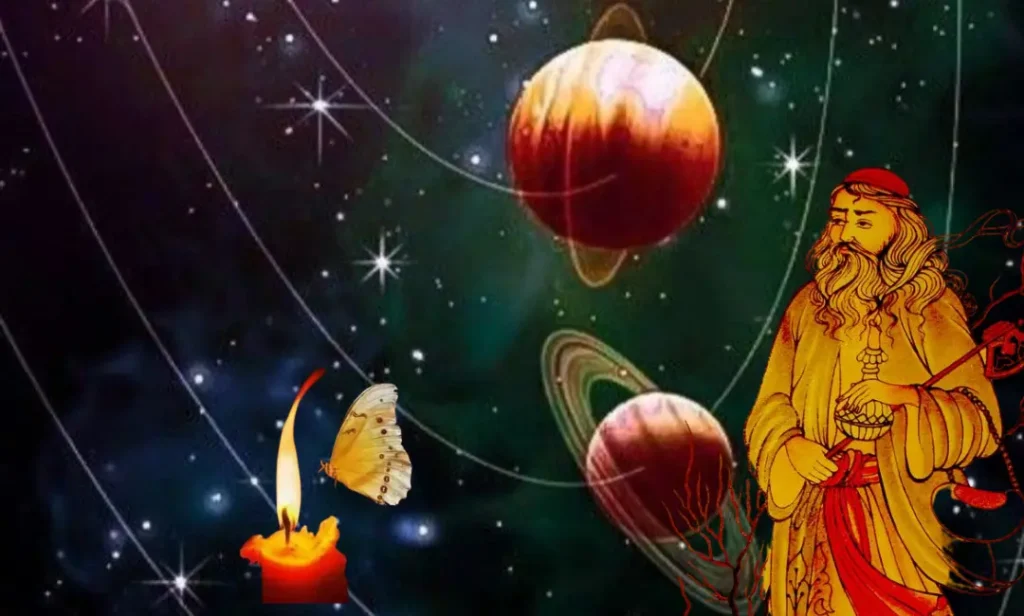
The epistle of Hayy ibn Yaqdhan by Ibn Tufail of Andalusia stands as the most complete narrative and philosophical realization of Avicenna’s dream of “Oriental Wisdom.” It is not merely an allegory, but a “metaphysical laboratory” proving that the philosophical question, if left to its primordial nature (Fitra), is capable of crossing from the tangibles of matter to the lights of Divine Truth without a human teacher.
Ibn Tufail utilized the character of “Hayy” as a model for the human being who navigates metaphysical “convolutions” through self-effort. Hayy begins with the physics of anatomy (Aristotle) and concludes with the metaphysics of annihilation (Fana’) (Plotinus). Upon reaching the peak of his contemplation, Hayy found no refuge in the language of logic; here, Ibn Tufail’s “Oriental” text reveals itself:
“When he cast off his body and all bodily faculties… he witnessed a single Essence, which is the True Essence, the Necessary Being… and he witnessed within It a splendor, radiance, and beauty that tongues cannot describe.”
This text embodies the “Gnostic Wisdom” heralded by Avicenna. The metaphysical question for Hayy ibn Yaqdhan shifted from “Inference through Creation” to “Immersion in the Truth.” Ibn Tufail demonstrated that “Reason” and “Revelation” (represented later by the character Absal) meet upon a single bedrock; what Hayy perceived through taste and witnessing is identical to what the Divine Law brought through symbols and parables. Thus, Hayy ibn Yaqdhan became the “metaphysical icon” proving that the philosophical question is a ladder-like journey that begins with “Why?” and ends with “He,” achieving total connection between the organized mind and the longing soul.
Al-Ghazali: The Critical Inversion
The experience of Abu Hamid al-Ghazali represents the most dangerous turning point in the history of the metaphysical question within Islamic civilization. Al-Ghazali’s protest was not a superficial religious rejection; it was an “attack from within the fortress,” utilizing the tools of the philosophers (Logic) to shake their confidence in the “intellect’s capacity” to encompass metaphysics. Al-Ghazali sought to protect the “sanctity of the Unseen” from the “audacity of the intellect,” attempting to remove the existential question from dry demonstrative circulation and place it within the realm of faith-based and gnostic experience.
1. The Intentions of the Philosophers: The Weapon of "Understanding Before Critique"
Before Al-Ghazali began dismantling the Peripatetic edifice, he took a brilliant methodological step in his book, The Intentions of the Philosophers (Maqasid al-Falasifa). In this work, he presented the philosophy of the Peripatetics (specifically Avicenna) with such honesty and clarity that some readers initially mistook him for one of them. His goal was to prove that his critique did not stem from ignorance, but from a total mastery of their methodologies. The metaphysical bedrock here is Al-Ghazali’s implicit declaration: “I understand your logic better than you do, yet I will demonstrate its incoherence.”
2. The Incoherence of the Philosophers: The Shattering of Reason Before Metaphysics
In his shocking work, The Incoherence of the Philosophers (Tahafut al-Falasifa), Al-Ghazali focused his attack on twenty issues. The philosophical core of the book centered on a single idea: “The impotence of demonstration in theology.” Al-Ghazali argued that philosophers who adhere to strict logic in mathematics and natural sciences inevitably collide with “contradiction” and “conjecture” when they transition to metaphysics.
In the introduction to the Tahafut, he writes:
“These philosophers believe that their demonstrations in theology are as rigorous as their proofs in geometry and arithmetic. How far from the truth! Metaphysics is not a field for rational demonstration independent of Revelation.”
3. Removing the "Question" from Rational Circulation
Al-Ghazali struck at the heart of “Rational Necessity,” particularly regarding the issue of Causality. While philosophers argued that fire burns by its very nature and essential necessity, Al-Ghazali contended that the connection between fire and burning is a “habit” (‘ada) ordained by God, not a logical necessity. This skepticism aimed to liberate the Divine Will from the “shackles of Aristotelian logic.”
Through this methodology, the metaphysical question for Al-Ghazali was no longer “What does reason say?” but rather “What does Revelation say, and what does the heart feel?” He opened a massive breach in the Peripatetic wall, asserting that metaphysics is not attained through syllogism but through “a light that God casts into the breast.” In doing so, Al-Ghazali paved the way for transforming metaphysics from “rational proof” into “mystical unveiling,” a path later completed by Suhrawardi and Ibn Arabi, albeit from illuminative perspectives.
Averroes (Ibn Rushd): The Great Commentator and the Return to Rational Purity
Averroes represents the “Great Commentator” and the turning point back toward Rational Purity. His project was not merely a rebuttal of Al-Ghazali, but a radical attempt to “purify” the metaphysical question from the remnants of Neoplatonism that had permeated the works of Al-Farabi and Avicenna, and from the “disturbances” of the Kalam (theology) schools that had turned dogma into verbal polemics. Averroes sought to restore the “Aristotelian Aristotle”—the Aristotle of demonstration and realism—away from the “fantasies” of emanation or the “impositions” of the theologians.
1. The Critique of "Avicennism" and the Return to the Aristotelian Core
Averroes (Ibn Rushd) argued that Avicenna and Al-Farabi erred when they diluted metaphysics with Neoplatonic mysticism. He criticized the Theory of “Emanation,” viewing it as a departure from the logic of causes and effects. In his seminal work, The Incoherence of the Incoherence (Tahafut al-Tahafut), he asserts that existence does not require intermediary “Ten Intellects” to flow from the One; rather, nature operates by the necessity of its divine order. He extracted the metaphysical question from the “impurity” of imagination to return it to the “solidity” of natural demonstration, maintaining that “Existence and Essence” are one and the same in reality. His critique of Avicenna was explicit:
“Avicenna erred when he thought that existence is an accident that supervenes upon essence; the truth is that existence is the very essence of things in the external world.”
2. The Critique of the Theologians in The Methodology of Proofs
In his foundational book, The Exposition of the Methods of Proofs (Al-Kashf ‘an Manahij al-Adilla), Averroes launched a methodological attack on the Ash’arites, Mu’tazilites, and literalists. He considered their methods for proving God’s existence (such as the argument from huduth or temporal createdness) to be “invented” methods—neither demonstratively philosophical nor purely scriptural—that only led to confusion and sectarianism. Averroes salvaged the metaphysical question from “sectarian circulation” and anchored it in two Quranic proofs that align with demonstrative reason:
- The Argument from Providence (Inaya): That everything in the universe is subservient to the needs of human existence, indicating a Willful Creator.
- The Argument from Invention (Ikhtira’): That existents are brought into being from nothingness, aligning with the logic of Causality.
Averroes states:
“The paths taken by the theologians to know God are not the paths called for by the Divine Law, nor do they lead to demonstrative certainty… they are merely whims and confusion.”
3. The Averroist Bedrock: Reason and Revelation as Twin Sisters
Averroes made metaphysics the bedrock upon which rational truth and scriptural truth converge. In The Decisive Treatise (Fasl al-Maqal), he established his famous rule: “Truth does not contradict truth, but rather agrees with it and bears witness to it.” This return to Aristotle was not a rejection of religion but a belief that the “System of the Universe” is the truest witness to the “Organizer,” and that the logical intellect is the only tool capable of understanding this system.
Through this, Averroes moved the metaphysical question out of the “shades of the Unseen” discussed without proof, and away from “mystical illuminations” without reason, returning it to the “Light of Nature” and the Aristotelian logic of causality. He thus founded a rationalism that would eventually enlighten the European Renaissance as it did the rigorous Arab mind.
The Hidden Battle: Metaphysical Inquiry and the "Illuminationist" (Ishraqi) Resistance
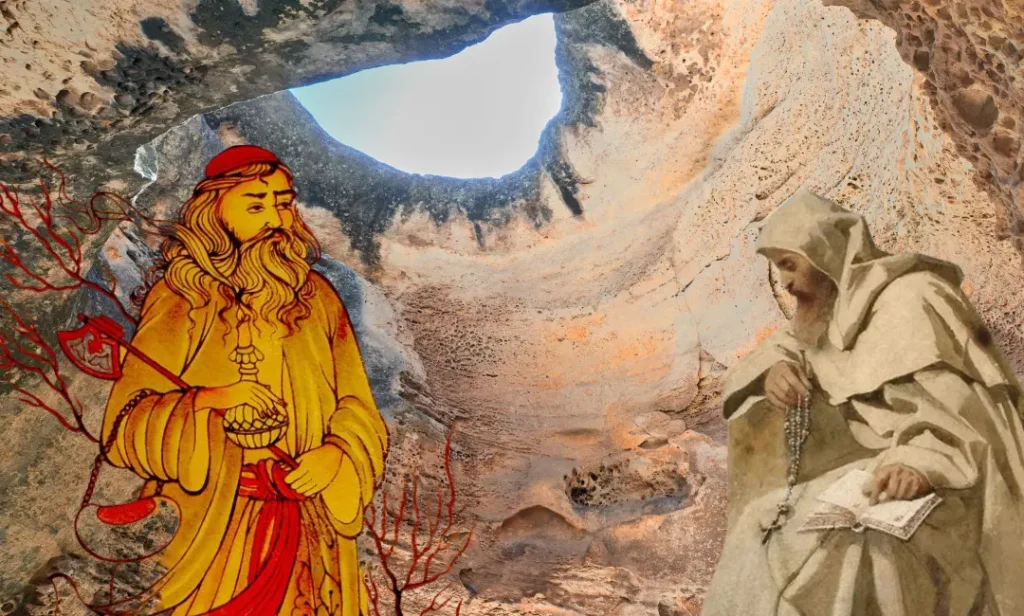
The school of “Illuminationist Wisdom” (Hikmat al-Ishraq), founded by Shihab al-Din al-Suhrawardi (The Slain), represents the greatest “philosophical resistance” against what might be termed the “Tyranny of Peripatetic Rationalism” that Averroes sought to establish.
While Averroes was pulling the metaphysical question toward the “solidity of matter” and the logic of Aristotelian demonstration, Suhrawardi was pulling it toward the “subtlety of light” and the logic of unveiling and witnessing (mushahada). Suhrawardi considered the Peripatetic mind to be “lame,” unable to reach the core of reality unless illuminated by a divine light cast by God into the heart of the seeker.
1. The Reality of Illumination: Metaphysics as "Manifestation," Not "Inference"
For Suhrawardi, Illumination (Ishraq) is not merely a mystical emotion; it is an epistemological method based on “Knowledge by Presence” (al-‘Ilm al-Huduri). While Peripateticism seeks truth through “Acquired Knowledge” (al-‘Ilm al-Husuli)—the arrangement of premises to reach conclusions—Illumination posits that metaphysics is the direct “manifestation of truth to the self.” The metaphysical bedrock shifted from “Existence” (Avicenna) or “Matter” (Averroes) to “Light.” For Suhrawardi, all existence consists of “degrees of lights,” and God is the “Light of Lights” (Nur al-Anwar), from whom all beings emanate according to their proximity or distance from Him.
2. Sources of Illuminationist Philosophy: Reclaiming Eastern Wisdom
Suhrawardi did not limit himself to Greek thought; he revolutionized the sources of the metaphysical question by reclaiming the “Wisdom of the Ancient Persians” (Khasrawani wisdom) and merging it with the “Wisdom of Ancient Egypt” (Hermeticism) and the contemplations of Plato. Suhrawardi believed in an “eternal leaven” of wisdom passed down through nations, which Greek Peripateticism (Aristotle) had severed with its logical dryness. In the introduction to his book, The Philosophy of Illumination, he writes:
“In what I have mentioned regarding the Science of Lights… I have been aided by those who traveled my path, the god-like sages of Persia such as Jamasp and Farshoshtar—not the infidel Magi, but the sages who saw Light as the reality of existence.”
3. Great Questions: From "Why" to "How Do We See?"
The Illuminationist school posed entirely different metaphysical questions:
- Essence and Existence: In a hidden battle with the Peripatetics, Suhrawardi considered “Existence” to be a mere mental abstraction, while the true reality is the “Luminous Essence.”
- The World of Image (Alam al-Mithal): Suhrawardi asked, “Where do forms go?” He established the concept of the Imaginal World (the realm of Hurasqalya or Hashtarabad). This is an intermediary world (Barzakh) between pure matter and pure spirit, containing archetypal cities and suspended forms, visited by prophets and gnostics in their visions.
- The Soul and the Return to Light: The metaphysical question here is one of “alienation.” The soul is a “strange light” that has fallen into the “dusk” of matter (the body), and its perfection lies in the journey of return to the “Sunrise of Lights.”
Suhrawardi succeeded in undermining “despotic rationalism” by proving that the highest level of certainty is “Witnessing” (Mushahada), not “Syllogism.” Metaphysics was thus transformed from a “mental construct” into an “existential realization,” paving the way for the greatest philosophical synthesis in Islamic history: the “Transcendent Philosophy” (al-Hikma al-Muta’aliyah) of Sadr al-Din al-Shirazi.
The Philosophical Question in Transcendent Philosophy: Mulla Sadra Shirazi
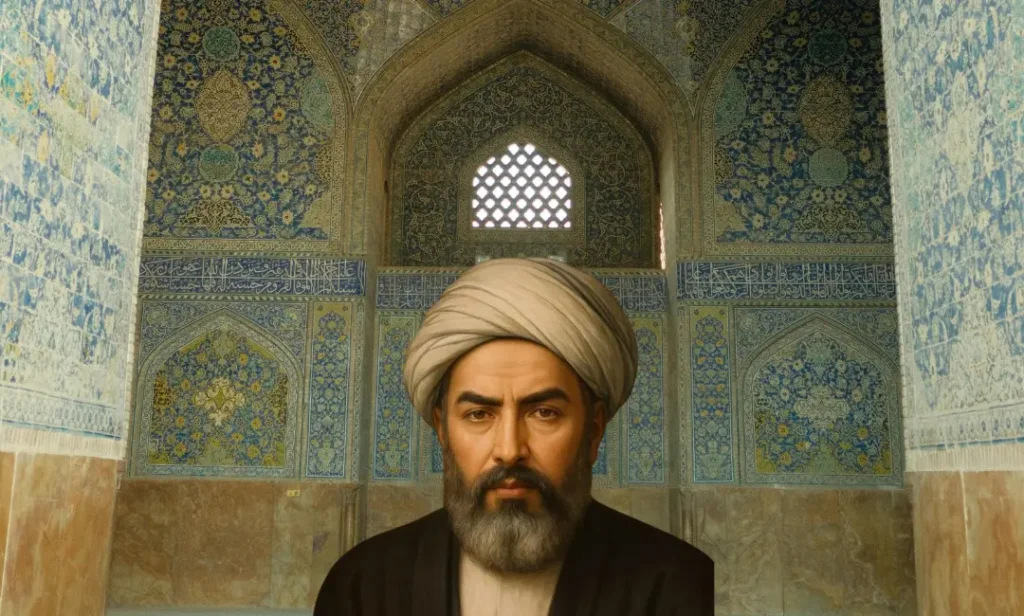
The journey of the metaphysical question reaches its grandest and most mature station with Sadr al-Din al-Shirazi (Mulla Sadra). He did not merely combine previous schools; he fused them into a single crucible. Before him, the philosophical question was scattered between Aristotelian rigor, Suhrawardian illumination, and the gnosis of Ibn Arabi. Sadra emerged to reframe “Existence” as a single reality with varying degrees, utilizing immense cognitive tributaries to make metaphysics a comprehensive science of Demonstration, Gnosis, and Revelation (Quran).
1. From the Primacy of Quiddity to the Primacy of Existence: Overturning the Metaphysical Hierarchy
The traditional question revolved around “What is the thing?” (Quiddity). However, Mulla Sadra, drawing from the gnostic insights of Ibn Arabi, overturned this by declaring that “Existence” (Wujud) is the fundamental reality, while quiddity (Mahiyya) is merely a conceptual limitation.
- The Dilemma: How can things be simultaneously diverse and unified?
- The Sadrian Answer: Through the concept of the “Gradation of Existence” (Tashkik al-Wujud). Existence is a single reality that spans from the Necessary Being down to Prime Matter (Hyle). The difference between beings is not in kind, but in “intensity and weakness.”
- From The Four Intellectual Journeys (al-Asfar al-Arba‘a):
“Existence is a simple, external reality; it is the root of all things, and quiddities are abstracted from it… It is at the peak of manifestation in its reality, yet at the peak of hiddenness in its essence.”
2. Substantial Motion: The Question of Eternal Renewal within Essence
Mulla Sadra solved a dilemma that defeated Aristotelian Peripateticism. While Aristotle restricted motion to “accidents” (quantity, quality), Sadra proved that “Substance” itself is in motion.
- The New Question: Are things fixed in their essence and changing only in form, or is existence in a state of constant flow?
- The Vision: Existence is a continuous “Becoming.” The universe is a “new creation” at every moment (inspired by the verse: “Nay, they are in confusion about a new creation”). This solved the problem of the “Temporal Creation of the World”; the world is temporally originated because its very essence is in constant renewal.
3. Divine Knowledge and Governance: The Divine Self as an Ontological Ocean
Utilizing the texts of Ibn Arabi’s Fusus al-Hikam, Mulla Sadra transformed the question of “Divine Knowledge” from formal knowledge to “Knowledge by Presence” (al-‘Ilm al-Huduri).
- The Metaphor: Just as a human knows their own mental images directly without an intermediary, the entire world consists of “images” within God’s knowledge—rather, it is the very manifestation of the world’s dependence on the Creator.
- Governance: God does not govern the world from the outside like a detached craftsman. Rather, He is “The Simple Reality is All Things” (Basit al-haqiqa kull al-ashya’); He encompasses all perfections of existence without being limited by the boundaries of quiddities.
4. The Union of the Intellector and the Intellected and the Corporeal Resurrection
Here, Mulla Sadra’s courage shines in confronting traditional Kalam (theology). He utilized Avicenna’s texts on the “Soul” and developed them to align with the Quranic vision of the Resurrection.
- The Question of Resurrection: How is man resurrected in both body and spirit?
- The Answer: Through the theory of “Material in Origination, Spiritual in Survival.” The soul begins materially and then ascends through Substantial Motion to become abstract. Resurrection is not a return to a dense material body, but to an “Imaginal Body” created by the soul through its creative power—it is the same body from the world in “form,” but not in “matter.”
- Key Text: “In the hereafter, the soul is the builder of its own body. He whose soul is luminous, his body shall be Paradise; he whose soul is dark, his body shall be Hell.”
With Transcendent Philosophy, metaphysics became an unshakeable “bedrock.” It absorbed the spiritual unveilings of Ibn Arabi, the logical rigor of Avicenna, and the illuminative light of Suhrawardi, fusing them into a demonstrative Quranic discourse. Thus, the trajectory of the metaphysical question in Islamic thought concluded with this paradigm: viewing existence as a single, moving, God-centered unity, eternally striving toward its Absolute Perfection.
Conclusion: The Eternal Return—An Existential Thirst Unquenched by Answers
We conclude this long intellectual odyssey with a title that encapsulates both the tragedy and the glory of the human condition: “The Eternal Return of the Metaphysical Question.” After traversing these diverse schools, systems, and demonstrations, it appears that the “Question” never truly dies. Instead, it rests momentarily, only to be reborn in the heart of every new generation—as if it were a predestined fate for this being who dwells upon the earth while his eyes remain fixed upon the heavens.
The metaphysical question is not a “problem” to be solved, but a “mystery” to be lived. The scholastic multiplicity we have traced—from Babylon to Al-Shirazi—the power of rational abstraction honed by Aristotle, and the depth of the spiritual experience braved by Suhrawardi and Ibn Arabi, were all attempts to mend a profound rift in the human entity. This “existential thirst” does not stem from ignorance; rather, it arises from the fact that man is a “liminal being” (ens limitaris), standing upon the Barzakh (isthmus) that separates matter from spirit, and finitude from eternity.
The eternal return of the metaphysical question is manifest in the fact that, despite the explosion of science and technology, we continue to pose the same questions asked by the prisoner in Plato’s cave, the hermit in the forests of India, and the contemplative soul in the deserts of Andalusia: Why is there something rather than nothing? What is Being? Are we merely passing atoms, or are we “secrets” imprisoned in bodies?
This question constantly rebounds upon us because it is not an intellectual luxury; it is the “Sisyphus’ stone” that the human mind carries with pride. Whenever we believe that the Logos has finally subjugated existence, “spiritual flashes” burst forth to declare that Truth is far wider than logic. And whenever matter drowns us in its atoms, “Illumination” arrives to remind us that Light is the origin.
Human perplexity in the face of metaphysics is a “positive perplexity”; it is the very force that prevents thought from petrification and ensures that philosophy remains a continuous adventure that does not end with the final page of a book. We are condemned to this eternal return—not as a punishment, but as a perennial invitation to Transcendence. It is as if the voice of Existence is whispering to us: “Every time you answer a question, you lose a piece of your wonder; therefore, return to the Question to reclaim your humanity.” Thus, the metaphysical question remains the solid bedrock upon which we strike with the pickaxe of thought—not to shatter it, but to extract from it the spark of Meaning in a silent universe.