
Phase One: Birth, Lineage, and Upbringing in El Guettana (1808–1830 AD)
Emir Abdelkader ibn Muhyiddin al-Jaza’iri was born on September 6, 1808 (15 Rajab 1223 AH) in the village of El Guettana, situated on the banks of Wadi al-Hammam, west of Mascara in the fertile Ghriss Plain. El Guettana was a tranquil Sufi retreat (Zawiya), surrounded by palm and olive groves, serving as a center for learning and spiritual education in western Algeria. His father, Muhyiddin, chose this location to be far from the clamor of cities, providing an ideal environment for raising his son in an atmosphere of asceticism and contemplation. This birth in a rural, mystical setting—only two decades before the French invasion—ensured that Abdelkader grew up in a purely traditional Islamic world, shielding him from early European influences and instilling in him a profound sense of belonging to his land, faith, and history.
Noble Lineage and the Al-Muhyiddin Family
Abdelkader belonged to a noble Hashimite-Hassani family, known as the “House of Muhyiddin,” one of the most prestigious scholarly and Sufi families in Algeria. According to traditional accounts, their lineage traces back to Imam al-Hasan ibn Ali ibn Abi Talib. His father, Sheikh Muhyiddin ibn Mustafa (d. 1833 AD), was a prominent Maliki jurist and the leader of the Qadiriyya Order in western Algeria. Known as “Sidi Muhyiddin,” he commanded immense respect among the tribes. This noble lineage provided Abdelkader with early religious and tribal legitimacy, which later enabled him to unite disparate tribes under the banner of resistance (Jihad), as the people saw him as an extension of an ancient scholarly and spiritual heritage.
Sufi Education and the Qadiriyya Order
Abdelkader was raised within the fold of the Qadiriyya Sufi Order, founded by Sheikh Abdul Qadir al-Jilani (d. 561 AH). The Zawiya of El Guettana was its primary hub in Algeria. He received an early spiritual education at the hands of his father, memorizing the Quran by the age of ten and studying jurisprudence (Fiqh), Hadith, linguistics, literature, and mysticism (Tasawwuf). The Qadiriyya in Algeria harmonized asceticism with scholarship and social struggle. This Sufi upbringing endowed Abdelkader with the ethics of chivalry (Furusiyya), generosity, and courage, planting the seeds of humility, justice, and tolerance that would later define his treatment of French prisoners and his protection of Christians in Damascus.
Tribal Environment and Early Chivalry
Abdelkader spent his childhood in a traditional tribal social environment. Before the French occupation in 1830, Algeria was a diverse Islamic society where tribes dominated the hinterlands and Sufi Zawiyas acted as centers of mediation and education. In western Algeria, tribal loyalty was potent, yet institutions like El Guettana softened conflicts and unified people around faith. This environment taught Abdelkader the arts of horsemanship, marksmanship, and combat from a young age. It also granted him a deep understanding of Algerian social dynamics, which later empowered him to build an organized state amidst chaos.
Analytical Insight
Abdelkader’s upbringing in El Guettana—within a noble Qadiriyya family and a tribal-mystical society—was decisive in shaping his character. By synthesizing religious scholarship, Sufi discipline, and tribal prowess, he emerged as a leader possessing a rare blend of religious, tribal, and military legitimacy. This balance between the spiritual and the practical allowed him to lead a 15-year resistance, establish a modern state in the face of colonialism, and leave behind a global humanitarian legacy that transcends armed struggle to encompass justice and tolerance.
Phase Two: Education, Sufi Training, and the Great Journey (1820–1830 AD)
During his early twenties (c. 1820–1825 AD), Abdelkader received intensive and systematic education at the hands of his father, Sheikh Muhyiddin, in the Zawiya of El Guettana. The Sheikh was a disciplined teacher and a wise mentor who harmonized Sacred Law (Sharia) with Sufi upbringing. He began by ensuring his son memorized the Holy Quran at a very young age, then progressed to Arabic linguistics, Maliki jurisprudence, Hadith, and Exegesis (Tafsir). Education was a daily ritual conducted in an atmosphere of asceticism, interspersed with training in horsemanship, marksmanship, and swimming, to cultivate both body and soul. This domestic study within the mystical environment of the Zawiya provided Abdelkader with a formidable foundation in Islamic sciences, earning him the title of “The Young Scholar” (Al-Alim al-Saghir) by the age of eighteen.
Spiritual Discipline and Character Building
Under his father’s guidance, Abdelkader’s roots in the Qadiriyya Order were further solidified. Muhyiddin initiated him into the stations (Maqamat) of the path from childhood, teaching him the litanies (Dhikr), solitary retreats (Khalwa), and the inward struggle against the self (Mujahada). The focus was on ethical refinement, instilling principles of generosity, humility, courage, and justice, inspired by the life of Sheikh Abdul Qadir al-Jilani. In his memoirs, Abdelkader recounts spending long hours in meditation and contemplation, which granted him early spiritual clarity. Analytically, this Sufi upbringing was the cornerstone of his balanced personality, enabling him later to be a warrior who treated captives with mercy and a statesman who built a nation on moral foundations.
The Pilgrimage to Mecca (1825–1828 AD)
In 1825, when Abdelkader was about seventeen, Sheikh Muhyiddin decided to take his son on a long pilgrimage to Mecca. This was a pivotal opportunity to complete his education and broaden his horizons. They traveled from Algeria through Tunisia and Tripoli, then by sea to Egypt and onto the Hejaz. Abdelkader performed the Hajj with his father, circumambulating the Kaaba and visiting the Prophet’s Mosque in Medina, which deepened his connection to the Prophetic tradition (Sunnah). This journey was an extension of his Sufi training; they spent significant time in worship and seclusion, and Abdelkader witnessed the diversity of the Islamic Ummah by meeting pilgrims from every corner of the globe.
Wandering through the Islamic East
The journey extended beyond the Hejaz to other historic Islamic lands. They visited Baghdad, the birthplace of Sheikh Abdul Qadir al-Jilani, where they renewed their spiritual covenant at his shrine. They then traveled to Damascus and Jerusalem. In these cities, Abdelkader met with eminent scholars, including Sufi masters in Baghdad and Hanafi and Shafi’i jurists in Damascus. The entire journey lasted nearly three years (until c. 1828), returning via Egypt where they met with the scholars of Al-Azhar. These visits opened Abdelkader’s eyes to the vast Islamic world and granted him early political insight into the state of the Ummah under Ottoman rule.
Analytical Insight
The impact of this journey on Abdelkader was profound, both intellectually and spiritually. In the East, he encountered diverse Sufi currents and was influenced by scholars who harmonized the Outward Law (Shara’) with the Inward Truth (Haqiqa), reinforcing his concept of a combined spiritual and military struggle (Jihad). The journey bestowed upon him an early intellectual maturity, allowing him to see Algeria as part of a much larger Islamic civilization. This exposure to the East distinguished Abdelkader from other resistance leaders; he synthesized local Algerian heritage with a global Islamic vision, a synthesis that would later manifest in his organized statecraft and humanitarian treatment of his adversaries.
Phase Three: The French Invasion and the Rise of Abdelkader (1830–1832 AD)

The French invasion of Algeria commenced on June 14, 1830, when a massive military force of 37,000 soldiers, led by General de Bourmont, landed at Sidi Fredj beach, west of Algiers. The official pretext for the invasion was the “Fan Affair” of 1827—where the Dey Husayn struck the French consul with his fly-whisk—but the true motives were economic and political. France, under King Charles X, sought to bolster domestic popularity and regain colonial prestige. Algiers fell on July 5, 1830, following devastating bombardment, and the Dey Husayn surrendered, ending 300 years of Ottoman rule. While the French expanded along the coast, the hinterlands remained defiant.
Analytical Insight:
This invasion was a civilizational shock; in a matter of weeks, a sovereign Islamic state was transformed into a European colony. The Ottoman military was not organized enough to repel a modern invasion, leading to internal political chaos. However, this trauma awakened a national and religious consciousness, paving the way for local leaders—supported by tribes and Sufi Zawiyas—to emerge from the vacuum left by a collapsing central authority.
The Resistance of Sheikh Muhyiddin
Following the fall of the capital, spontaneous resistance erupted in the countryside, particularly in the west among the Hashim and Hachem tribes. Sheikh Muhyiddin, Abdelkader’s father, emerged as the spiritual and military leader. From the Zawiya of El Guettana, he called for Jihad and successfully unified the tribes of Mascara and Oran against the French advance. Between 1831 and 1832, Muhyiddin led successful strikes, preventing the French from total control over the west. Abdelkader, then only twenty-two, fought alongside his father, gaining vital early military experience.
Analytical Insight:
Muhyiddin’s role was pivotal in transforming the resistance from tribal fragmentation into an organized struggle. By leveraging his Sufi standing within the Qadiriyya Order, he provided a religious legitimacy that surpassed the crumbling Ottoman administration. This phase prepared the ground for the transition of leadership to Abdelkader, who synthesized his father’s scholarly and mystical heritage with field-tested military expertise.
The Pledge of Allegiance (Al-Bay’ah)
On November 22, 1832, tribal leaders from Mascara, Oran, and Mostaganem gathered at the Ghriss Plain near Mascara to pledge their allegiance (Bay’ah) to Abdelkader as their Emir. Initially, there was hesitation due to his young age (24 years), but Sheikh Muhyiddin proposed his son for the leadership, asserting that he was divinely chosen for the task. Under a historic tree (the Elm tree), the leaders proclaimed him “Commander of the Faithful” (Amir al-Mu’minin) in the West. Abdelkader vowed to establish a just Islamic state and called for a comprehensive national resistance.
Analytical Insight:
This pledge was a transformative historical moment, marking the birth of the first modern Algerian state in the shadow of colonialism. The choice of Abdelkader, despite his youth, reflects the tribes’ wisdom in prioritizing religious and scholarly legitimacy over seniority. In his person, he unified noble lineage, Sufi discipline, and military bravery, enabling him to unite historically fractured tribes. This was not merely a military appointment; it was the declaration of an independent state whose future organizational efficiency would soon astonish Europe.
Phase Four: Founding the Modern Algerian State (1832–1839 AD)
Immediately following his pledge of allegiance in November 1832, Abdelkader set out to construct a structured and organized state. He began by forming a regular standing army that integrated tribal cavalry with disciplined, trained infantry. He established arms factories in Tagdempt (his mobile capital) and Mascara, producing gunpowder and cannons, and implemented European-style training methods inspired by his own observations. He divided the administration into provinces governed by trusted lieutenants known as Khalifas—such as Ibn Allal in Tlemcen—supported by Sharia judges and consultative councils. Tagdempt flourished as an administrative hub, complete with markets, schools, and hospitals.
Analytical Insight:
This state-building was a feat of genius within a fragmented tribal context. Abdelkader transformed from a resistance leader into a modern statesman, synthesizing Islamic law with practical organizational tactics. He successfully unified rival tribes through religious legitimacy and justice, prompting the French to describe him as the “Arab Napoleon.”
Economic Reforms and Sovereignty
On the economic front, Abdelkader asserted sovereignty by minting copper and silver coins bearing his name and the Hijri date, such as the Budju and the Nasiriya, to unify trade. He implemented a fair taxation system based on Sharia (Zakat and Ushr), while exempting the poor, and established a national treasury (Bayt al-Mal) to fund the resistance and public works like roads and fortresses. These reforms ensured economic independence from France while encouraging agriculture and domestic trade.
Analytical Insight:
These measures demonstrated Abdelkader’s brilliance in building a sustainable war economy. By grounding his fiscal policy in Islamic jurisprudence, he secured tribal loyalty. The currency served as a political symbol of independence, and fair taxation prevented internal rebellions, allowing the state to endure years of blockade.
Diplomacy and Strategic Treaties
In February 1834, Abdelkader signed the Desmichels Treaty, in which France recognized his sovereignty over the west (Oran, Mostaganem, and Mascara) in exchange for his recognition of their presence on the coast. The treaty was a diplomatic triumph, granting him time to consolidate his state and gain implicit recognition of his political entity.
His influence expanded further with the Treaty of Tafna on May 30, 1837, signed with General Bugeaud. France recognized Abdelkader’s sovereignty over two-thirds of Algeria—stretching from the Sahara to Tlemcen and east toward Kabylie—in exchange for his neutrality in the eastern theater. This was the zenith of French recognition, rendering his state almost internationally acknowledged.
Analytical Insight:
These treaties showcased Abdelkader’s political acumen. He exploited the rivalries between French generals to gain ground, even while knowing these agreements were temporary. Tafna, in particular, was a masterclass in diplomacy that humiliated the French command temporarily, though it eventually revealed France’s total colonial intent when they violated it two years later.
Military Prowess: The Battle of Macta
This period also saw significant military victories, most notably the Battle of Macta on June 28, 1835. Abdelkader defeated General Trézel by luring his army into the marshes of the Macta River, resulting in a crushing defeat for the modern French military and the capture of hundreds of soldiers.
Analytical Insight:
These early battles highlighted Abdelkader’s mastery of irregular warfare, utilizing terrain and popular support. His victories forced France to the negotiating table but also awakened their resolve for a later policy of “total conquest.” These years represented the peak of his state—a model of a modern Islamic nation resisting colonial expansion.
Phase Four: Founding the Modern Algerian State (1832–1839 AD)
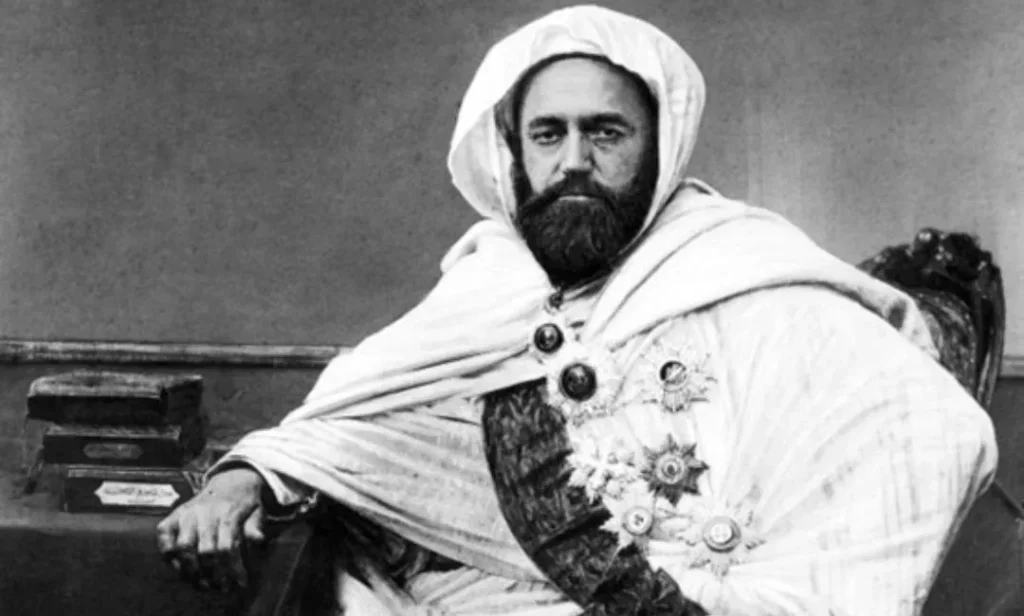
Immediately following his pledge of allegiance in November 1832, Abdelkader set out to construct a structured and organized state. He began by forming a regular standing army that integrated tribal cavalry with disciplined, trained infantry. He established arms factories in Tagdempt (his mobile capital) and Mascara, producing gunpowder and cannons, and implemented European-style training methods inspired by his own observations. He divided the administration into provinces governed by trusted lieutenants known as Khalifas—such as Ibn Allal in Tlemcen—supported by Sharia judges and consultative councils. Tagdempt flourished as an administrative hub, complete with markets, schools, and hospitals.
Analytical Insight: *This state-building was a feat of genius within a fragmented tribal context. Abdelkader transformed from a resistance leader into a modern statesman, synthesizing Islamic law with practical organizational tactics. He successfully unified rival tribes through religious legitimacy and justice, prompting the French to describe him as the “Arab Napoleon.”
Economic Reforms and Sovereignty
On the economic front, Abdelkader asserted sovereignty by minting copper and silver coins bearing his name and the Hijri date, such as the Budju and the Nasiriya, to unify trade. He implemented a fair taxation system based on Sharia (Zakat and Ushr), while exempting the poor, and established a national treasury (Bayt al-Mal) to fund the resistance and public works like roads and fortresses. These reforms ensured economic independence from France while encouraging agriculture and domestic trade.
Analytical Insight:
These measures demonstrated Abdelkader’s brilliance in building a sustainable war economy. By grounding his fiscal policy in Islamic jurisprudence, he secured tribal loyalty. The currency served as a political symbol of independence, and fair taxation prevented internal rebellions, allowing the state to endure years of blockade.
Diplomacy and Strategic Treaties
In February 1834, Abdelkader signed the Desmichels Treaty, in which France recognized his sovereignty over the west (Oran, Mostaganem, and Mascara) in exchange for his recognition of their presence on the coast. The treaty was a diplomatic triumph, granting him time to consolidate his state and gain implicit recognition of his political entity.
His influence expanded further with the Treaty of Tafna on May 30, 1837, signed with General Bugeaud. France recognized Abdelkader’s sovereignty over two-thirds of Algeria—stretching from the Sahara to Tlemcen and east toward Kabylie—in exchange for his neutrality in the eastern theater. This was the zenith of French recognition, rendering his state almost internationally acknowledged.
Analytical Insight:
These treaties showcased Abdelkader’s political acumen. He exploited the rivalries between French generals to gain ground, even while knowing these agreements were temporary. Tafna, in particular, was a masterclass in diplomacy that humiliated the French command temporarily, though it eventually revealed France’s total colonial intent when they violated it two years later.
Military Prowess: The Battle of Macta
This period also saw significant military victories, most notably the Battle of Macta on June 28, 1835. Abdelkader defeated General Trézel by luring his army into the marshes of the Macta River, resulting in a crushing defeat for the modern French military and the capture of hundreds of soldiers.
Analytical Insight:
These early battles highlighted Abdelkader’s mastery of irregular warfare, utilizing terrain and popular support. His victories forced France to the negotiating table but also awakened their resolve for a later policy of “total conquest.” These years represented the peak of his state—a model of a modern Islamic nation resisting colonial expansion.
Phase Five: Life in Eastern Exile—Bursa then Damascus (1852–1883 AD)
In December 1852, Napoleon III released Emir Abdelkader after five years of detention in France, on the condition that he would not return to Algeria. He first moved to Bursa in Ottoman Anatolia, where he resided with his family and followers in a grand palace provided by Sultan Abdulmejid I. Surrounded by historical mosques and lush gardens, he lived a relatively quiet life for three years (1853–1855), dedicated to worship and reading. However, the cold climate took a toll on his health.
In 1855, at his own request, he moved to Damascus, settling in the Al-Amara district near the Umayyad Mosque. He purchased a spacious residence that became a hub for scholars and dignitaries. In 1863, he performed the Hajj once more.
Analytical Insight:
The transition from Bursa to Damascus was a shift from relative isolation to integration into a vibrant Islamic heartland. It allowed him to reconnect with his Sufi roots and provided him with a global humanitarian platform, transforming his exile from a punishment into a phase of intellectual and moral maturity.
Sufi Scholarship and the Great Jihad
In Damascus, Abdelkader returned to an intensive life of spiritual scholarship, spending his days teaching and practicing the litanies of the Qadiriyya order. He established a scholarly circle (Halqa) in his home, teaching jurisprudence, mysticism, and Hadith, and occasionally led congregations at the Umayyad Mosque. Deeply immersed in the works of Ibn Arabi and Al-Ghazali, he was profoundly inspired by the concepts of “The Oneness of Being” (Wahdat al-Wujud) and universal tolerance.
Analytical Insight:
This period was a maturation of his early upbringing into a “Practical Sufism” that blended asceticism with humanitarianism. Abdelkader moved beyond armed struggle to what he termed the “Greater Jihad”—the struggle for self-refinement—becoming a model for the mystic who transcends conflict to reach universal ethics.
The Hero of Damascus: The 1860 Riots
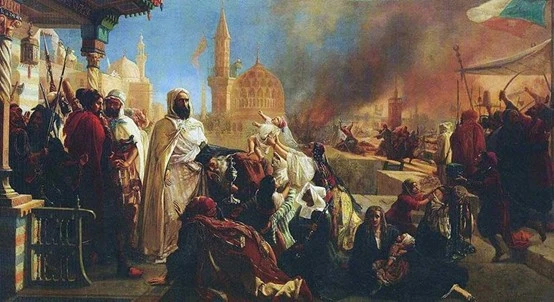
His humanitarian legacy reached its zenith in July 1860 during the Damascus riots, when sectarian violence broke out between Druze and Christians. As thousands of Christians were being massacred, Abdelkader led his Algerian guards to intervene. He sheltered approximately 15,000 Christians within his own residence and in various consulates, risking his life to protect them. He wrote letters to Druze leaders urging mercy, grounding his pleas in Islamic principles.
Analytical Insight:
This act was the ultimate manifestation of Abdelkader’s Sufi ethics—applying principles of tolerance during a crisis. His actions transformed his global image from a “warrior” to a “universal humanitarian.” He received the Grand Cross of the Legion of Honor from France and the admiration of Europe, cementing his legacy as a symbol of an enlightened, tolerant Islam.
Intellectual Legacy and Final Works
In exile, Abdelkader produced a wealth of intellectual works spanning mysticism, poetry, and political philosophy. His most prominent work is Kitab al-Mawaqif (The Book of Stations), a three-volume mystical masterpiece explaining the stages of the spiritual path and the secrets of Monotheism. He also wrote A Letter to the French (1855), defending Islam against colonial misconceptions and calling for justice and mutual respect.
Analytical Insight:
His intellectual output served as a substitute for his lost military struggle, distilling his experiences into a written heritage that combined the spiritual with the political. Al-Mawaqif remains a pinnacle of theoretical Sufism, while his letters demonstrate his diplomatic acumen in exile. These works immortalized him as a modern Islamic thinker who combined the spirit of resistance with civilizational dialogue.