
Introduction: The Voice of the Soul
Maulana Jalaluddin Rumi, a 13th-century sage, poet, and jurist, remains the most resonant voice of Sufism in the modern world. His teachings are not merely historical relics but living spiritual exercises aimed at the transformation of the human condition. At the heart of Rumi’s Sufism is a radical call to return to our origin—a journey powered by Love (Ishq) rather than cold logic. This article explores the intricate architecture of Rumi’s mystical path, examining the sacred bond between master and disciple, the ecstasy of the Sema, and the eternal duel between the intellect and the heart.
I. The Transformation
From Scholar to Mystic
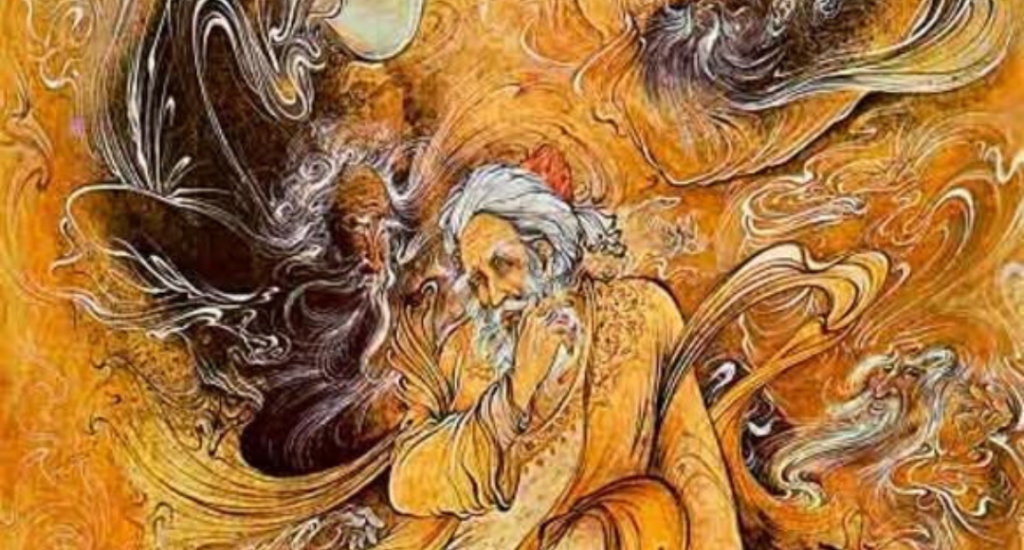
Before Rumi became the poet of love, he was a distinguished professor of theology in Konya. His life was defined by books, legal decrees, and religious lectures. However, the year 1244 marked a seismic shift when he met the wandering dervish, Shams-i Tabrizi.
This encounter represents the central Sufi tenet of Transformation. Shams acted as a “Divine Mirror,” reflecting back to Rumi the limitations of intellectual pride. Legend tells us that Shams threw Rumi’s precious books into a fountain, telling him that “knowledge that does not lead to the Truth is a burden.” This was the birth of Rumi the Mystic. He realized that while books provide information about the “water,” they cannot quench the “thirst.”
II. The Doctrine of Ishq: Love as the Primal Force
In Rumi’s worldview, Love (Ishq) is the fundamental fabric of the universe. It is not an emotion, but the very energy of God that sustains existence.
1. The Alchemy of Love
Rumi describes Love as an alchemist that turns the “copper” of the ego into the “gold” of the spirit. He posits that human beings are born with a deep sense of separation—a “wound” caused by our departure from the Divine presence. While intellect (Aql) tries to understand God through logic and theology, Love achieves what the mind cannot.
2. Case Study: Moses and the Shepherd
To illustrate that Divine Love transcends formal ritual, Rumi tells the story of Moses and a simple shepherd. Moses overheard a shepherd praying to God in a very “human” way: “O God, where are You? I want to sew Your clothes, wash Your socks, and comb Your hair.” Moses, shocked by this apparent blasphemy, rebuked him, saying God is beyond physical needs. The heartbroken shepherd fled into the desert.
However, God then rebuked Moses, saying: “You have parted My servant from Me. I do not look at the tongue and the speech; I look at the spirit and the inward feeling.” This story teaches that the “formalism” of religion is a shell, while the “essence” is the sincerity of the heart. For Rumi, a “blasphemous” word spoken with love is dearer to God than a thousand prayers said with pride.
III. The Duel Between Reason and Love: Aql vs. Ishq
A recurring theme in the Masnavi is the tension between the “Partial Intellect” (Aql-e-Juz’i) and “Divine Love.” Rumi compares the intellect to a cane used by a blind man; it is useful for navigating the material world, but it cannot “see” the Light itself.
The mind is cautious and concerned with self-preservation, whereas Love is reckless and self-sacrificing. Rumi uses the metaphor of a merchant versus a lover: the merchant counts his profit and loss, but the lover risks everything for a single glance from the Beloved. In the journey toward God, there comes a point where the “ladder of reason” must be left behind. Love has the “security clearance” to enter the Divine Presence where reason must wait outside.
IV. Sema: The Sacred Dance and the Music of the Spheres
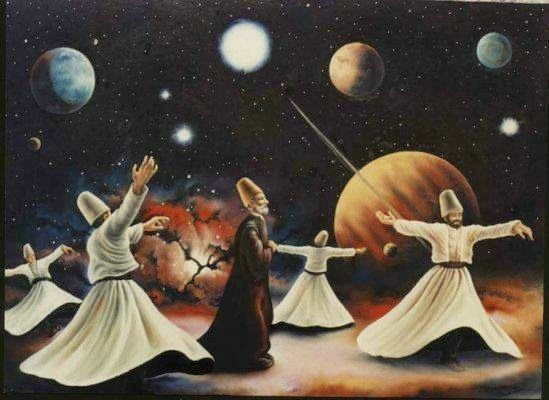
The Sema, or the whirling of the dervishes, is perhaps the most iconic symbol of Rumi’s path. For Rumi, the Sema was a physical manifestation of the soul’s ecstatic response to Divine Truth.
1. The Philosophy of Whirling
The act of whirling is a symbolic representation of the universe. Everything in existence—from atoms to galaxies—is in a state of rotation. By whirling, the dervish (Semazen) consciously joins this cosmic dance. One hand is raised to heaven to receive Divine grace, and the other is turned toward the earth to distribute that grace to humanity.
2. The Symbolism of the Attire
Every element of the Sema ceremony is rich with meaning:
- The Sikke (Tall Brown Hat): Represents the tombstone of the ego (Nafs).
- The White Robe (Tennure): Represents the ego’s shroud.
- The Black Cloak: Represents the material world. When the dervish removes the cloak, it symbolizes his spiritual rebirth.
3. The Birth of the Sema: The Goldsmith’s Shop
The origin of Rumi’s whirling is said to have occurred in the marketplace of Konya. As Rumi passed by the shop of a goldsmith named Salahuddin Zarkub, the rhythmic sound of the hammers hitting the gold began to sound like the Dhikr (remembrance) of “Allah, Allah.” Rumi, overwhelmed by this beauty, began to turn in circles in the middle of the street. This emphasizes that Sema is not a choreographed performance but a spontaneous eruption of joy when the soul recognizes God in the mundane.
V. The Sacred Bond: The Relationship Between Murshid and Murid
The path of Sufism is treacherous, making a spiritual guide (Murshid or Sheikh) indispensable. The disciple (Murid) requires a guide to navigate the traps of the ego.
1. The Mirror of the Soul
Rumi teaches that the Murshid is like a mirror. A disciple cannot see his own spiritual blemishes without a clear reflection. The Sheikh does not “give” the disciple anything new; rather, he helps the disciple remove the rust from the mirror of his own heart. This relationship is built on Taslim (submission)—a surrender to the Divine wisdom flowing through the guide.
2. Case Study: The Grammarian and the Boatman
Rumi uses humor to teach the necessity of surrendering intellectual pride to a guide. He tells of a proud grammarian who boarded a boat and asked the boatman if he knew grammar. When the boatman said “No,” the grammarian replied, “Half your life has been wasted!” Later, a storm hit, and the boat began to sink. The boatman asked, “Do you know how to swim?” The grammarian said “No.” The boatman replied, “Then your whole life is wasted, for the boat is sinking!” In Rumi’s Sufism, “grammar” represents intellectual knowledge, while “swimming” represents the spiritual surrender (Fana) taught by a Master. When the “storm” of death comes, only the “art of swimming” allows the soul to survive.
VI. Fana and Baqa: The End of the Journey
Rumi’s Sufism culminates in the concept of Fana fi-Allah (Annihilation in God) and Baqa bi-Allah (Subsistence in God).
- Fana: This is the “death before death.” It is the total removal of the false “I.” Rumi uses the metaphor of a moth being consumed by a candle flame. The moth becomes the flame; its individual identity is lost in the greater light.
- Baqa: Once the ego is gone, the seeker “returns” to the world, but with a transformed consciousness. They act and speak through God.
VII. The Universal Call and Social Service
One of the reasons Rumi remains relevant is his radical inclusivity. He famously invited everyone—regardless of creed—to the “caravan of hope.” His Sufism is a “Religion of the Heart.”
Furthermore, Rumi’s mysticism was not solitary. He taught that the heart that loves God must inevitably love God’s creation. A true Sufi is one who serves others, practices radical patience, and meets hatred with kindness. The “dance” of the dervish is meant to lead to a life of service, where spiritual heights are used to heal a broken world.
VIII. The Concept of 'The Universal Man' (Al-Insan al-Kamil)
The ultimate goal of Rumi’s Sufi path is to become a “Universal Man.” This is a person who has completely polished the mirror of their heart until it reflects all the attributes of God. This explains why Rumi’s funeral in 1273 was attended by people of all faiths—Muslims, Christians, and Jews. They all claimed him as their own because he had reached a state of love that was larger than any single label.
Conclusion: The Wound and the Light
Maulana Jalaluddin Rumi’s Sufism is a vast ocean that encompasses the depth of a scholar, the passion of a lover, and the grace of a dancer. By focusing on Ishq (Love) as the primary motivator, the Sema as the cosmic alignment, and the Murshid as the essential guide, Rumi offers a path that is as relevant today as it was eight centuries ago.
His message remains simple yet revolutionary: “Your task is not to seek for love, but merely to seek and find all the barriers within yourself that you have built against it.” Through the path of Rumi, the human soul learns to stop crawling and begins to fly on the wings of Divine Love. The reed flute’s song continues to echo, calling every soul back to the reed bed of the Beloved.
Bibliography
- Primary Sources (Translations of Rumi’s Works):
- Arberry, A. J. (1961). Tales from the Masnavi. London: Allen & Unwin. (يوفر ترجمة دقيقة للقصص التي ذكرناها مثل قصة النحوي والملاح).
- Barks, Coleman. (1995). The Essential Rumi. San Francisco: HarperCollins. (أشهر ترجمة شعرية حديثة ركزت على مفهوم العشق).
- Nicholson, Reynold A. (1925-1940). The Mathnawi of Jalaluddin Rumi. 8 Vols. London: Luzac & Co. (المرجع الأكاديمي الأهم لترجمة المثنوي بالكامل مع التعليق).
- Schimmel, Annemarie. (2004). The Triumphal Sun: A Study of the Works of Jalaloddin Rumi. New York: SUNY Press. (تحليل عميق لصور الرومي الشعرية).
- Secondary Sources (Scholarly Analysis):
- Chittick, William C. (1983). The Sufi Path of Love: The Spiritual Teachings of Rumi. Albany: State University of New York Press. (هذا الكتاب هو المرجع الأساسي لمفهوم “العشق” و”العقل” كما ورد في المقال).
- Lewis, Franklin D. (2000). Rumi: Past and Present, East and West – The Life, Teachings, and Poetry of Jalâl al-Din Rumi. Oxford: Oneworld Publications. (أشمل سيرة ذاتية للرومي توضح علاقته بشمس التبريزي وتاريخ الطريقة المولوية).
- Nasr, Seyyed Hossein. (1987). Islamic Art and Spirituality. Albany: SUNY Press. (يحتوي على فصول تشرح فلسفة السماع والرقص الصوفي).
- Underhill, Evelyn. (2002). Mysticism: A Study in the Nature and Development of Spiritual Consciousness. Mineola: Dover Publications. (للمقارنة بين تصوف الرومي والتصوف العالمي).
- Articles & Specialized Studies:
- Ömür, S. (2014). “The Symbolism of Sema: The Whirling Dervishes Ritual.” Journal of Sufi Studies. (دراسة متخصصة في رموز ملابس وحركات السماع).
- Wines, Leslie. (2000). Rumi: Spiritual Master and Poet. New York: Crossroads Publishing.