
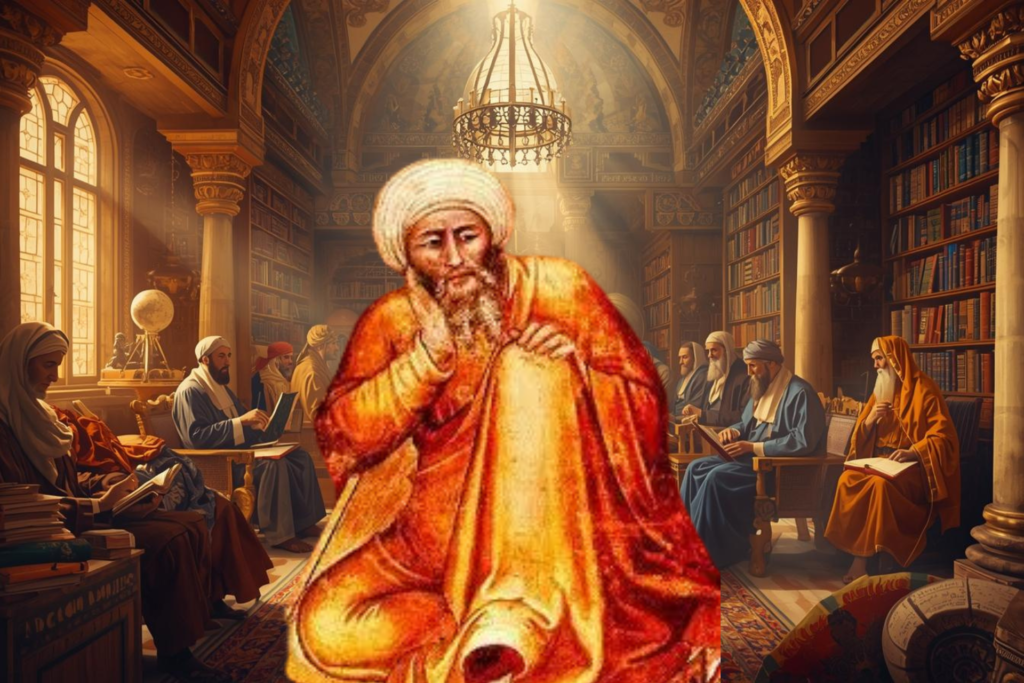
The Guardian of Reason and Faith: A Synthesis of Ibn Rushd’s Philosophy
Introduction
Abu al-Walid Muhammad ibn Ahmad ibn Rushd, known to the West as Averroes (1126–1198), stands as a titan of Islamic philosophy. The text at hand presents two of his most critical works: Fasl al-Maqal (The Decisive Treatise determining the nature of the connection between Religion and Philosophy) and Al-Kashf ‘an Manahij al-Adilla (The Exposition of the Methods of Proof). Together, these texts form a defense of rational inquiry, a critique of sectarian theology, and a framework for reconciling the apparent conflicts between Divine Law (Shari’ah) and Wisdom (Philosophy).
- The Legal Obligation of Philosophy
In Fasl al-Maqal, Ibn Rushd begins with a bold legal question: Is the study of philosophy permitted, prohibited, or commanded by Islamic Law? He concludes that the Law not only permits but obligatesthe study of philosophy for those capable of it.
He argues that the Quran frequently commands humans to reflect upon the heavens and the earth (e.g., “Reflect, you who have vision”). Since philosophy is nothing more than the investigation of existing beings as indications of their Artisan (God), the Law commands the use of the intellect. Ibn Rushd famously asserts:
“Truth does not contradict truth; rather, it agrees with it and bears witness to it.”
- The Hierarchy of Intellect and Methodology
A central theme in Ibn Rushd’s work is the categorization of human intellect into three distinct classes, each requiring a specific method of instruction:
- The Rhetorical Class (The Masses): They are persuaded by emotional arguments and literal interpretations of scripture.
- The Dialectical Class (The Theologians/Mutakallimun): They rely on debate and opinion, often using premises that are generally accepted but not necessarily certain.
- The Demonstrative Class (The Philosophers): They rely on Burhan (logical demonstration) and require absolute certainty.
Ibn Rushd argues that conflict arises when theologians (Ash’arites and Mu’tazilites) confuse the masses by introducing complex, often flawed interpretations that should be reserved for the demonstrative elite.
- The Doctrine of Ta’wil(Allegorical Interpretation)
When the conclusions of demonstrative philosophy (reason) appear to contradict the literal text of the Scripture, Ibn Rushd introduces the necessity of Ta’wil(allegorical interpretation). He argues that if reason proves a fact with certainty, and the Scripture seems to say otherwise, the Scripture must be interpreted allegorically to align with reason.
However, he sets strict rules: this interpretation should not be broadcast to the common masses, as it might shake their faith. The apparent meaning is for the masses, while the inner meaning is for the scholars “grounded in knowledge.”
- A Critique of Theology: The Kashf
In the second book, Al-Kashf, Ibn Rushd systematically dismantles the methods of the existing theological schools (Ash’arites, Mu’tazilites, and Literalists/Hashwiyya). He accuses them of creating complex, non-Quranic doctrines—such as “atomism” and the constant recreation of “accidents”—that make God’s existence seem like a riddle rather than a certainty.
Instead, Ibn Rushd proposes two simple, Quranic proofs for the existence of God that satisfy both the philosopher and the commoner:
- The Argument from Providence (Dalil al-Inaya): The observation that everything in the universe is perfectly suited for the existence and survival of human beings, implying a purposeful Creator.
- The Argument from Invention (Dalil al-Ikhtira’): The observation of the creation of life and complex structures (like the inorganic becoming organic), which necessitates an Inventor.
- Divine Knowledge and the World
The text addresses the controversial “Damima” (Appendix) regarding God’s knowledge. Ibn Rushd refutes the accusation that philosophers deny God’s knowledge of particulars. He clarifies that God’s knowledge cannot be compared to human knowledge. Human knowledge is causedby objects (passive), whereas God’s knowledge is the causeof the objects (active). Therefore, God knows particulars, but in a unique, superior way that transcends the human categories of “universal” and “particular.”
Regarding the creation of the world, Ibn Rushd navigates the debate between the world being “eternal” or “created in time.” He argues that the Quranic description suggests a continuous creation and that the world existed in some form (water, throne, time) before its current form, suggesting that the philosophical view of an eternal universe (in duration, not independence) is not contradictory to the text if understood correctly.
Conclusion
Ibn Rushd emerges from these texts not as an enemy of religion, but as its sophisticated guardian. He sought to protect the Shari’ah from the confusing distortions of dialectical theologians while simultaneously securing a safe space for philosophical inquiry. His legacy is the establishment of a rigorous epistemological framework where faith and reason are not rivals, but distinct paths to the same ultimate Truth.